- Harbourfront Quantitative Newsletter
- Posts
- The Effectiveness of Collar Structures in Equity and Commodity Markets
The Effectiveness of Collar Structures in Equity and Commodity Markets
Evidence from Index Hedging and Corporate Fuel Risk Management

Nam Nguyen
November 30, 2025 • Estimated Reading Time: 6 minutes
There are several popular options strategies frequently discussed in the trading and investing literature, as well as on social media. In a previous newsletter, we examined the effectiveness of the covered call strategy, which has gained wide adoption among retail investors. In this edition, we extend our critical evaluation to another widely used approach—the options collar, a strategy employed by both retail traders and institutional investors.
In this issue:
Latest Posts
Fractal Market Hypothesis: From Theory to Practice (11 min)
Volatility vs. Volatility of Volatility: Conceptual and Practical Differences (13 min)
Modeling Gold for Prediction and Portfolio Hedging (13 min)
Effectiveness of Covered Call Strategy in Developed and Emerging Markets (13 min)
Identifying and Characterizing Market Regimes Across Asset Classes (13 min)
Assessing the Effectiveness of Zero-Cost Collar in Different Markets
The zero-cost collar strategy is an options trading strategy that involves the simultaneous purchase of a put option and the sale of a call option. The options are usually of the same maturity, and the transaction results in a zero or small credit to the trader’s account.
This strategy is often used by investors who are bullish on a stock but want to protect themselves against a potential drop in the price. By buying the put option, they have the right to sell the stock at a predetermined price (the strike price). If the stock price falls below the strike price, they can sell the stock and offset any losses.
The sale of the call option helps to offset the cost of the put option and results in a zero or small credit to the trader’s account. This strategy is sometimes referred to as a “zero cost” collar because the net cost of the trade is zero.
Reference [1] examined the effectiveness of the zero-cost collar strategy in the developed and developing markets.
Findings
The paper’s objective is to provide investors with a continuously implemented trading strategy that can effectively handle turbulent market periods such as the Dotcom bubble, the 2008–2009 financial crisis, and the COVID-19 pandemic.
The study analyzes stock indices from six countries across both developed and developing economies to assess how extreme market events affect performance.
Zero-cost collars are proposed as a costless option-based protection strategy, created by equating the cost of the long and short option components.
Prior literature has not evaluated zero-cost collars across different rebalancing frequencies or tested their outcomes in both turbulent and stable markets.
Results show that zero-cost collars generate strong returns when market volatility is moderate, and the underlying indices perform well, especially when the put strike is set at a higher level.
The strategy performs respectably during severe downturns as well as during trending or declining markets.
Its effectiveness depends on market conditions and the choice of strike levels.
Overall, the paper contributes a practical trading strategy that helps investors manage turbulent market conditions through the continuous application of zero-cost collars.
Reference
[1] Lj Basson, Suné Ferreira-Schenk and Zandri Dickason-Koekemoer, The performance of zero-cost option derivative strategies during turbulent market conditions in developing and developed countries, Cogent Economics & Finance, Volume 10, 2022 – Issue 1
How the Airlines Hedge Fuel Costs
The recent rise in the cost of airline tickets can be attributed in part to the escalating fuel prices, which significantly affect operating expenses for airlines. To counter the adverse impact of fuel price volatility, airlines often adopt a strategic approach known as fuel hedging. This practice involves entering into financial contracts to secure future fuel purchases at predetermined prices, mitigating the vulnerability to sudden spikes in fuel costs. Fuel hedging provides airlines with a degree of price certainty, offering a measure of stability in budgeting and operational planning while allowing them to better manage the economic challenges posed by fluctuating fuel prices.
Amongst the US airlines, Southwest Airlines distinguishes itself for its efficient execution of the hedging strategy. It has maintained a record of profitability since 1973, an accomplishment that sets it apart in the US airline sector. Expert observers attribute Southwest’s sustained financial success to its proficient utilization of derivatives for the purposes of hedging. An analysis of Southwest Airlines’ financial statements across multiple years reveals a distinct trend: the share of jet fuel expenses is consistently lower compared to the industry norm. This achievement can be directly attributed to the precise implementation of their jet fuel hedging strategy, a practice that effectively shields the airline from fluctuations in fuel prices.
Reference [2] examined the fuel hedging strategy of Southwest Airlines in detail.
Findings
The paper analyzes why hedging jet fuel is critical for airlines, given the high volatility of oil prices, and highlights how Southwest Airlines’ long-term low-cost strategy is closely tied to its effective fuel-hedging program.
It examines Southwest’s financial background and stock performance as a foundation for evaluating its hedging approach.
The study identifies four key hedging strategies used by Southwest Airlines: call options, collar structures, call spreads, and put spreads.
By combining these four strategies, Southwest effectively mitigated jet-fuel price risk without engaging in speculative derivative positions.
A comparison with other airlines shows that Southwest’s disciplined, non-speculative approach contributed significantly to its hedging success and cost stability.
The paper also evaluates how COVID-19 and oil-price movements related to production-cut agreements adversely affected Southwest, leading to over-hedging and substantial losses in 2020.
In short, the paper discussed the intricacies of Southwest Airlines’ hedging strategies and demonstrated their value-added effect. It is apparent that the deployment of hedging by Southwest Airlines yields advantages. However, it is important to underscore the necessity of a well-designed hedging program, one that avoids the potential pitfall of over-hedging.
Reference
[2] Xiao Han, Hedging Strategy Analysis of Southwest Airlines, 2023, Proceedings of the 6th International Conference on Economic Management and Green Development
Closing Thoughts
Taken together, the two studies illustrate how collar-based strategies can play an important role in managing volatile market conditions, whether for broad equity portfolios or for highly fuel-sensitive industries such as airlines. The first study shows that zero-cost collars can deliver respectable risk-adjusted outcomes during major market disruptions, particularly when volatility is moderate, and strike selection is calibrated appropriately. The second study highlights how Southwest Airlines effectively applied options structures, including collars, to hedge jet-fuel exposure, while also underscoring the risks of over-hedging during periods such as COVID-19. Collectively, the evidence reinforces that collar strategies can be valuable risk-management tools, but their effectiveness depends critically on market regime, implementation frequency, and disciplined design.
Further Readings
To read about the effectiveness of the covered call strategy, check out the newsletter below.
A few months ago, we also discussed the volatility risk premium across different asset classes. At that time, I highlighted the video library of Dr. Ilia Bouchouev, a quant specializing in oil derivatives. There was no content on oil options trading then, but as anticipated, he has now released a new video on oil volatility trading. To read the past newsletter, follow the link below; to watch the video, proceed to the next section.
Educational Video
Virtual Barrels Quant Talk, Episode 5: Introduction to Oil Vol Trading
In this video, Dr. Ilia Bouchouev introduces the foundations of oil volatility trading, setting the stage for a full lecture series on the topic. He maps out the core participants in the oil options market—producers, airlines, refiners, dealers, quantitative funds, and retail traders—and explains how their hedging needs create persistent imbalances that drive most option-related opportunities. Producers hedge because lenders require downside protection, often using costless collars or three-way structures that result in net volatility selling, and he briefly discusses how zero-cost collars shape these flows. Airlines primarily buy calls or call spreads on refined products to manage jet-fuel exposure, while dealers sit in the middle, exploiting relative-value trades by buying cheap volatility from one group and selling expensive volatility to another, all while managing cross-commodity risks.
The video then shifts to the essential quantitative framework underlying volatility trading. Dr. Ilia Bouchouev explains realized, implied, and local volatility; the limitations of standard lognormal assumptions in energy markets; and why traditional percentage-based volatility measures are misleading for crude. He shows how Bachelier-style (normal) volatility is more appropriate for commodities, producing more intuitive and symmetric volatility smiles. He also highlights the volatility term structure and how short-dated options are tied to inventory-driven uncertainty. The lecture concludes with an outline of the six main sub-strategies in a professional oil-vol trading portfolio—including gamma, Vega, smile, term-structure, cross-product, and exotic strategies—which will be explored in later episodes.
Volatility Weekly Recap
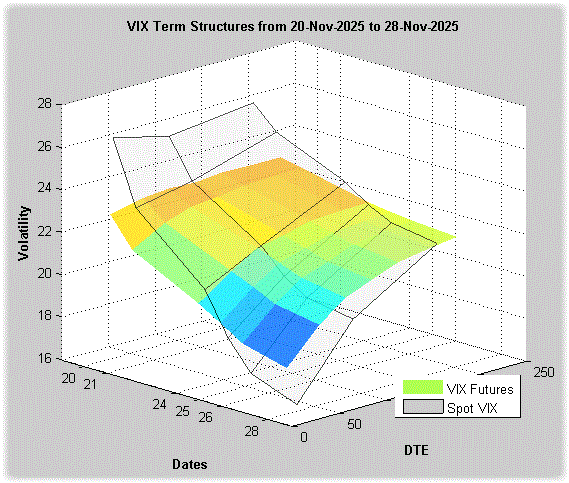
The figure below shows the term structures for the VIX futures (in colour) and the spot VIX (in grey).
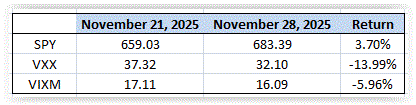
U.S. markets were closed Thursday for Thanksgiving, but the shortened week was enough to provide some relief to the equity market. The S&P 500 gained 3.73% and the Nasdaq rose 4.91%. Both oil and gold recovered slightly from last week’s lows. Bitcoin bounced back strongly over the past week, easing concerns among crypto investors that the bull market may be over, and Ethereum saw a similar move.

On the volatility front, both spot VIX and VIX futures declined and ended the week in solid contango. The roll yields were positive on both the short and middle segments of the term-structure curve.
Around the Quantosphere
A king of French quants launched this AI Masters course for finance professionals (efinancialcareers)
Some top masters in finance students make $550k. Most do not (efinancialcareers)
Goldman warns trend-followers may trigger $40bn in stock selling next week (hedgeweek)
Hedge funds scramble to cover short positions as stocks rebound (bloomberg)
As market rallied to record highs last quarter, ultra-rich family offices bought beaten up stocks (cnbc)
Tower Research is quietly recruiting top quants using hedge-fund style deals (businessinsider)
For tomorrow’s quants, Python is essential — AI isn’t (risk)
Hedge Fund of the Year: LMR Partners (risk)
Want to be a quant? Here’s how — and how not — to get hired (risk)
There is a $500m quant fund run by AI that might want to hire you (efinancialcareers)
BlackRock Bitcoin ETF Option Limits Face Massive Increase Under Nasdaq Proposal (coinmarketcap)
Here's how big-name hedge funds are using and investing in AI (businessinsider)
Disclaimer
This newsletter is not investment advice. It is provided solely for entertainment and educational purposes. Always consult a financial professional before making any investment decisions.
We are not responsible for any outcomes arising from the use of the content and codes provided in the outbound links. By continuing to read this newsletter, you acknowledge and agree to this disclaimer.