- Harbourfront Quantitative Newsletter
- Posts
- Machine Learning for Derivative Pricing and Crash Prediction
Machine Learning for Derivative Pricing and Crash Prediction
Exploring machine learning in derivatives and market risk

Nam Nguyen
March 08, 2026 • Estimated Reading Time: 6 minutes
Applications of machine learning in finance continue to evolve rapidly. In previous issues, we discussed both the uses and the challenges of applying machine learning in financial markets. In this edition, we continue that discussion by highlighting new research on machine learning approaches for pricing complex derivatives and identifying signals that may precede major market downturns.
In this issue:
Latest Posts
Upcoming Conference
I will be speaking at the Futures Alpha Conference in New York at the end of this month, participating in a panel discussion on Machine Learning in Asset Management. If you are attending, I would be glad to connect in person.

Futures Alpha brings together quants, portfolio managers, risk leaders, and trading technologists working across asset classes. Participants include practitioners from leading funds, asset managers, and investment banks.
If you plan to attend, you can use the link below and the discount code ADAM30 to receive a 30% discount.
Speeding Up Derivatives Pricing Using Machine Learning
A financial derivative is a contract whose value depends on the price of an underlying asset such as a stock, bond, commodity, or index. Accurate valuation of financial derivatives and their associated sensitivity factors is important for both investment and hedging purposes. However, many complex derivatives exhibit path-dependency and early-exercise features, which means that closed-form solutions rarely exist, and numerical methods must be used.
The issue with numerical methods is that they are often slow. As a result, efforts are being made to improve the efficiency of numerical techniques for valuing financial derivatives. Reference [1] proposed a fast valuation method based on machine learning. It developed a hybrid two-stage valuation framework that applies a machine learning algorithm to highly accurate derivative valuations incorporating full volatility surfaces. The volatility surface is parameterized, and a Gaussian Process Regressor (GPR) is trained to learn the nonlinear mapping from the complete set of pricing inputs directly to the valuation outputs. Once trained, the GPR delivers near-instantaneous valuation results.
Findings
The study develops a machine learning framework for pricing derivative products whose valuation depends on volatility surfaces.
Volatility surfaces are parameterized using the five-parameter SVI model with a one-factor term structure adjustment to generate realistic synthetic market scenarios.
High-accuracy valuations for variance swaps and American put options are computed using conventional numerical methods and used to create training and testing datasets.
A Gaussian Process Regressor is trained to learn the nonlinear relationship between input risk factors, such as volatility surface parameters, strike, and interest rate, and valuation outputs including prices and Greeks.
The trained model achieves high accuracy, with approximately 0.5% relative error for variance swap fair strikes and 1.7–3.5% relative error for American put prices and first-order Greeks.
The model is less accurate for the Gamma Greek due to discontinuities in the strike dimension.
After training, the machine learning model produces valuations almost instantly, achieving a speed improvement of three to four orders of magnitude compared with traditional numerical methods.
The results demonstrate that machine learning can enable real-time risk analytics, dynamic hedging, and large-scale scenario analysis for derivatives.
The framework is general and can be extended to other path-dependent derivatives with early exercise features.
In summary, the authors developed an efficient method to price complex financial derivatives using a machine learning technique. However, it is noted that GPR’s performance in valuing higher-order greeks is noticeably less accurate. Additionally, the study was conducted using synthetic data, so it would be useful to see the method applied to real-world scenarios.
Reference
[1] Lijie Ding, Egang Lu, Kin Cheung, Fast Derivative Valuation from Volatility Surfaces using Machine Learning, arXiv:2505.22957
Forecasting Market Crashes with Machine Learning Techniques
Reference [2] examines how machine learning can be used to predict market crashes within the Adaptive Market Hypothesis framework.
The study considers three categories of factors:
1. Internal factors, such as technical indicators designed to capture endogenous market dynamics, including momentum, trend strength, and money flow arising from investor behavior and adaptive learning;
2. External factors, including macroeconomic and commodity variables that proxy for systematic, exogenous risks affecting fundamental valuations; and
3. Volatility features that quantify market fear and uncertainty.
The author evaluates the performance of three predictive models—logistic regression, random forest, and a long short-term memory (LSTM) network.
Findings
While the Efficient Market Hypothesis suggests crashes cannot be predicted, the Adaptive Market Hypothesis allows for temporary periods of predictability as market conditions evolve.
The analysis compares a traditional econometric model, Logistic Regression, with machine learning approaches, including Random Forest and LSTM.
The models use a feature set combining technical, macroeconomic, and volatility-based indicators.
Model performance is evaluated using metrics designed for imbalanced classification problems, where crash events are rare but economically significant.
Empirical results show that the LSTM provides the best balance between precision and recall, although Logistic Regression remains competitive.
The findings highlight that simpler models can still perform effectively, supporting the value of model parsimony in turbulent market environments.
The results also support the Adaptive Market Hypothesis by showing that market predictability evolves over time and depends on changing conditions.
Logistic Regression performs well as an early-warning system due to its high recall, although it generates many false positives.
The LSTM model improves precision while maintaining strong recall, suggesting that capturing temporal patterns in financial data enhances predictive performance.
Overall, the study concludes that market crashes are not entirely random, but their prediction depends on the appropriate balance between model complexity and practical application.
In short, the study concludes that market crashes are difficult to forecast but not entirely random, and different models capture different aspects of predictability. Logistic regression functions well as a high-recall early warning tool, while LSTM models provide more balanced signals.
Reference
[2] Michele Della Mura, Predicting Stock Market Crashes, A Comparative Analysis of Econometric and Machine Learning Models, Politecnico di Torino, 2025
Closing Thoughts
Taken together, these studies illustrate the expanding role of machine learning in modern quantitative finance. One line of research demonstrates how machine learning models can dramatically accelerate the pricing of complex derivatives while maintaining high accuracy, enabling real-time risk management and large-scale scenario analysis. Another line of work explores the ability of both traditional econometric methods and advanced machine learning models to identify signals that may precede market crashes. Collectively, these findings show that machine learning is reshaping financial modeling, though simpler approaches can still play a meaningful role.
Additional Reading
For further discussion on machine learning, please refer to previous issues:
Educational Video
Using Reinforcement Learning to Hedge Derivatives by John Hull and Zissis Poulos
The seminar discusses research by John Hull and collaborators on applying reinforcement learning (RL) to derivative hedging. Traditional hedging relies on the Greeks, such as delta, gamma, and vega, and focuses on minimizing short-term portfolio sensitivity through frequent rebalancing. The authors argue that this approach is myopic and often leads to high transaction costs. Reinforcement learning instead treats hedging as a multi-period decision problem, where an algorithm learns trading actions that minimize portfolio risk over the entire life of the derivative rather than over the next small time interval.
Empirical results show that RL-based hedging can outperform traditional delta hedging and simple one-step optimization, particularly for complex derivatives such as barrier options, where discontinuities make standard hedging less effective. The approach also reduces trading activity by roughly 20–25%, leading to lower transaction costs while maintaining strong risk control. The authors conclude that reinforcement learning provides a flexible framework for risk management and may increasingly influence how large institutions hedge derivatives portfolios.
Volatility Weekly Recap
The figure below shows the term structures for the VIX futures (in colour) and the spot VIX (in grey).

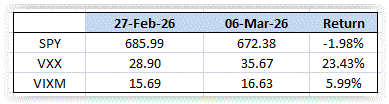
The S&P 500 opened lower at the start of the week due to the escalating conflict in Iran, but then staged a comeback and finished the day positive. A similar pattern occurred over the following two days. Renewed concerns about oil markets dragged equities lower on Thursday, and markets declined again on Friday following weaker-than-expected nonfarm payroll data. Overall, the S&P 500 fell 2.02% and the Nasdaq declined 1.24%.
Oil rallied sharply due to the geopolitical tensions, with crude oil trading above $90 per barrel by Friday, while West Texas Intermediate rose above $87. Gold initially rallied but then moved within a relatively narrow range. Bitcoin attempted to break above its recent trading range on Wednesday, rising more than 6%, but failed to hold those gains and returned to the range by Friday’s close.
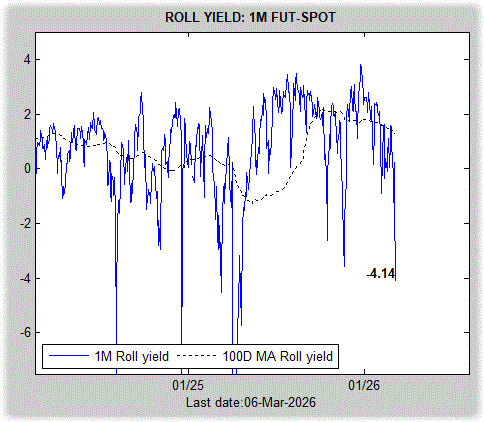
On the volatility front, the VIX index closed above 29 for the first time in more than 200 days. Both spot VIX and futures moved into backwardation, with spot VIX rising much faster than futures, resulting in a strongly negative roll yield.
Around the Quantosphere
Fleet of AI Bots Will Supercharge Hedge Fund Power, Nettimi Says (bloomberg)
Big Lenders’ Risky Loans Are Rattling Wall Street (nytimes)
What Can Quant Trading Strategies Teach Us About Markets? (bloomberg)
Jane Street May Not Be Bitcoin’s Problem as On-Chain Data Tells a Different Story (finance yahoo)
Hedge Funds Hike Bullish Oil Bets to 22‑Month High on Iran Risks (bloomberg)
Billionaire family offices invested in pro soccer, bitcoin and semiconductors before the new year (cnbc)
Asset manager paying nearly $400k per head hikes compensation amdist AI rollout (efinancialcareers)
Hedge funds’ need for juniors is getting intense. European traders have had their best time in a decade (efinancialcareers-canada)
The real winners of Trump’s global tariff war: law firms, hedge funds and AI (theguardian)
How Algorithmic Trading Powered by AI Influences Stock Market Liquidity (ibsintelligence)
Polymarket Ends Trading Loophole for Bitcoin Quants (protos)
How AI Is Helping Retail Traders Exploit Prediction Market Glitches to Make Easy Money (coindesk)
Riskiest CLO Funds Are Flashing a Warning Sign (financialpost)
Disclaimer
This newsletter is not investment advice. It is provided solely for entertainment and educational purposes. Always consult a financial professional before making any investment decisions.
We are not responsible for any outcomes arising from the use of the content and codes provided in the outbound links. By continuing to read this newsletter, you acknowledge and agree to this disclaimer.