- Harbourfront Quantitative Newsletter
- Posts
- Modern Pairs Trading: What Still Works and Why
Modern Pairs Trading: What Still Works and Why
Is Pairs Trading Still Profitable? A Modern Review

Nam Nguyen
January 25, 2026 • Estimated Reading Time: 4 minutes
Pairs trading, or statistical arbitrage (stat arb), is a classic, well-established quantitative trading strategy, and it is still in use today. I discussed its profitability in a previous newsletter, and in this edition, we continue that discussion.
In this issue:
Latest Posts
Implied vs. Realized Volatility in Delta Hedging Strategies (10 min)
Wrap-Up 2025: Popular Topics and Reader Engagement (4 min)
Risk, Leverage, and Optimal Betting in Financial Markets (11 min)
The Effectiveness of Collar Structures in Equity and Commodity Markets (12 min)
Fractal Market Hypothesis: From Theory to Practice (11 min)
Pairs Selection Methods
Reference [1] provides a thorough review of the pairs trading literature between 2016 and 2023.
Pair selection is a critical step in pairs trading, and the paper offers a comprehensive review of the various pair selection methods used in practice. They are:
1-Distance Methods
Use SSE/SAE of normalized price differences to identify co-moving assets. Simple, intuitive, and historically profitable across markets, even after costs.
2-Cointegration Methods
Exploit long-run equilibrium relationships. Strong empirical support across equities and bonds, with advances in regime switching and external-factor integration.
3-Stochastic Control Methods
Model pairs trading as a continuous-time optimization problem. Incorporate jumps, regime changes, and stochastic volatility, showing strong performance but facing practical frictions.
4-Time Series Methods
Use GARCH, OU, and fractional OU to model short-term dynamics and volatility clustering. Adaptive thresholds improve returns; hybrid models are an emerging area.
5-Other Methods
Copulas capture tail dependence; Hurst exponent methods capture long memory; entropic approaches address model uncertainty. These improve robustness under nonlinear dynamics.
Overall, the review helps practitioners adapt stat-arb techniques to new markets and regimes. While simple methods once worked well, today’s competitive environment often requires more sophisticated approaches, though success still depends on model design, data quality, and market regime.
Profitability of Pairs Trading
There is an ongoing debate in the literature—some argue that “pairs trading is dead,” while others maintain that it remains profitable. From this review paper [1], we learn the following.
1- Pairs trading remains profitable, but returns are weaker and more conditional
The survey explicitly notes that profitability persists, but is not uniform and depends on market conditions, costs, and implementation details:
Empirical evidence consistently shows that distance-based pairs trading can be profitable across different markets, asset classes, and time horizons.
However, this is immediately tempered elsewhere by declining performance stability:
Performance is not uniform over time: profitability tends to vary with market volatility, and Sharpe ratios decline in certain subperiods.
2. Transaction costs and competition materially erode profits
Modern profitability survives only after careful cost control, unlike the early 2000s results:
Even after accounting for realistic transaction costs, the strategy remains profitable in several markets.
3. Advanced methods outperform naïve approaches
The paper makes clear that simple Gatev-style [2] implementations are no longer sufficient:
The apparent simplicity of GGR's strategy becomes less evident as more sophisticated models and techniques have been introduced.
And later:
Regime-switching structures … demonstrate superior performance, particularly under frequent or pronounced regime shifts.
In short, the paper does not argue that pairs trading has stopped working, but it makes clear that the simple, mechanical versions that worked in the 1990s and early 2000s no longer deliver robust returns. Profitability today is weaker, highly dependent on market regimes, and much more sensitive to transaction costs and execution. What survives is not the original Gatev–Goetzmann–Rouwenhorst method [2], but more adaptive, model-driven implementations that account for changing volatility, correlations, and liquidity.
Reference
[1] Sun, Y. (2025). A survey of statistical arbitrage pairs trading strategies with non-machine learning methods, 2016-2023. WNE Working Papers, 19/2025 (482). Faculty of Economic Sciences, University of Warsaw
[2] Gatev, E., Goetzmann, W., & Rouwenhorst, K. G. (2006). Journal of Financial Economics, 81(1), 105–141.
Closing Thoughts
The paper provides a thorough review of all existing pair selection methods, which are critical to pairs trading. It also concludes that current profitability is weaker, highly dependent on market regimes, and significantly more sensitive to transaction costs and execution.
Educational Video
Advanced Pairs Trading Lecture Series (Hudson & Thames)
This lecture series on advanced pairs trading by Hudson & Thames presents a range of trading strategy concepts and advanced techniques, covering several distinct trading approaches. Below is a detailed description of the distance approach, while additional methodologies can be found on their website.
The video presents a clear, research-oriented introduction to statistical arbitrage. It explains the economic intuition behind the strategy—identifying assets that historically move together and trading temporary deviations from that relationship—while focusing on the distance approach as a simple and intuitive method for pair selection. The discussion walks through normalization, distance metrics, and trading rules, emphasizing why the approach gained early popularity due to its transparency and ease of implementation.
The lecture then shifts to a critical assessment of performance and limitations. It highlights the deterioration of profitability after the mid-2000s, sensitivity to transaction costs, and the lack of strong economic foundations in pure distance-based methods. These weaknesses motivate later developments in the literature, including cointegration-based selection, dynamic modeling of spreads, and extensions using time-series techniques and machine learning, reinforcing the view that while classic pairs trading remains conceptually important, robust profitability increasingly depends on more sophisticated modeling and execution.
Volatility Weekly Recap
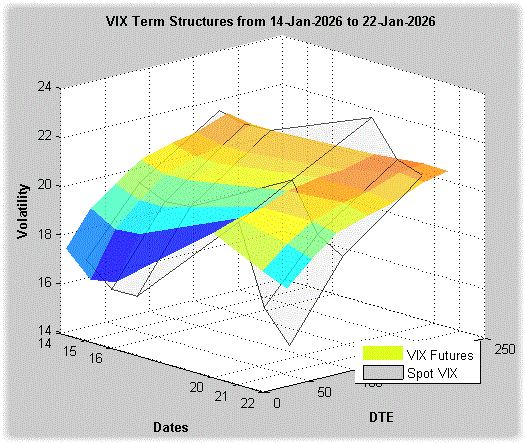
The figure below shows the term structures for the VIX futures (in colour) and the spot VIX (in grey).
The equity market opened a shortened week with the S&P 500 falling nearly 2% following comments by President Trump regarding Greenland, before reversing the next day after further remarks from the President. Markets continued to recover on Thursday and into the weekend; overall, the S&P 500 declined 0.4% and the Nasdaq gained 0.2%.
Gold and silver prices surged to new highs during the week. In contrast, the cryptocurrency market followed the equity market lower, declining sharply on Tuesday but failing to mount a meaningful recovery heading into the weekend.

On the volatility front, despite a brief spike, both spot VIX and VIX futures remained in contango. The roll yield experienced a short-lived dip toward zero but quickly recovered to firmly positive levels. As a result, despite the decline in the S&P 500, both VXX and VIXM posted negative returns of -1.22% and -1.0%, respectively. While infrequent, this outcome does occur and was also observed a few weeks ago.

Around the Quantosphere
Quant hedge funds see worst drawdown since October as crowded trades unwind (hedgeweek)
Trend-Chasing Traders Soar Just as Market Whiplash Tests Models (bloomberg)
Mystery Trader Earns $280,000 by Exploiting Quantitative Trading Models in Prediction Markets (kucoin)
Advice from quant executives on succeeding in systematic trading (businessinsider)
Quants, lawsuits and politics: Inside London's super-secretive trading firms (fnlondon)
Man Group plc: How a Quant Powerhouse Is Re-Architecting Active Investing (ad-hoc-news)
Hedge Funds Are Back on Top After a Long Alpha Winter (wsj)
Wall Street’s Information Gold Rush: Quantitative Giants Build Out Prediction Market Desks as Volume Shatters Records (chroniclejournal)
They quit their day jobs to bet on current events. A look inside the prediction market mania (npr)
Wall Street Quants Move Into Prediction Markets to Hunt for Arbitrage, Not to Bet (financemagnates)
The Trends That Will Define Hedge Funds in 2026 (ai-cio)
Hedge fund Rokos Capital Management pays its people $500k per head (efinancialcareers)
Disclaimer
This newsletter is not investment advice. It is provided solely for entertainment and educational purposes. Always consult a financial professional before making any investment decisions.
We are not responsible for any outcomes arising from the use of the content and codes provided in the outbound links. By continuing to read this newsletter, you acknowledge and agree to this disclaimer.