- Harbourfront Quantitative Newsletter
- Posts
- Implied vs. Realized Volatility in Delta Hedging Strategies
Implied vs. Realized Volatility in Delta Hedging Strategies
Which Volatility Matters for Delta Hedging? Evidence from Index Options

Nam Nguyen
January 11, 2026 • Estimated Reading Time: 4 minutes
Delta hedging is a fundamental topic in portfolio and risk management. In this edition, we discuss which volatility measure should be used in the delta hedging process, while a future edition will examine the appropriate hedging frequency and time horizon.
In this issue:
Latest Posts
Wrap-Up 2025: Popular Topics and Reader Engagement (4 min)
Risk, Leverage, and Optimal Betting in Financial Markets (11 min)
The Effectiveness of Collar Structures in Equity and Commodity Markets (12 min)
Fractal Market Hypothesis: From Theory to Practice (11 min)
Volatility vs. Volatility of Volatility: Conceptual and Practical Differences (13 min)
Which Free Lunch Would You Like Today Sir?
Reference [1] is a classic article on delta hedging that addresses the following question: if an investor has an accurate estimate of future realized volatility that differs from current implied volatility, a position can be initiated to exploit this discrepancy and then dynamically hedged—but which volatility should be used as the input in the hedging process?
Hedging with Actual Volatility
Pros
Hedging with actual volatility guarantees the final profit at expiration, equal to the difference between theoretical option values under actual and implied volatility.
The final profit has zero variance, making it attractive from a long-term, global risk–reward perspective.
Expected profit is often insensitive to small errors in the volatility used for hedging, providing some robustness to estimation error.
Cons
Mark-to-market P&L during the life of the option can fluctuate significantly, which is problematic for short-term risk management.
Interim P&L depends on the true drift of the underlying asset, introducing uncertainty before expiration.
In practice, traders are rarely confident in their estimate of actual volatility, weakening the appeal of this approach.
Hedging with Implied Volatility
Pros
Mark-to-market P&L evolves smoothly with no random fluctuations, which is advantageous for daily risk monitoring.
The trader only needs to be directionally correct about volatility (i.e., actual > implied or vice versa), not to estimate actual volatility precisely.
Implied volatility is directly observable from the market, simplifying implementation.
Cons
The final profit is path-dependent and therefore uncertain at inception.
While profits are always positive in expectation, their magnitude cannot be known in advance.
Profitability depends on the realized price path, particularly whether the underlying remains near regions of high gamma.
Reference
[1] R Ahmad, P Wilmott, Which Free Lunch Would You Like Today Sir?, Wilmott, 2005
Delta Hedging with Implied vs. Historical Volatility
Similar to the previous paper, Reference [2] examines the effectiveness of hedging using implied versus realized volatility. The study is based on empirical analysis using index ETF options, specifically the Nasdaq-100 ETF (QQQ).
Findings
The study examines the role of volatility estimation in delta-neutral hedging, with a focus on short-term options trading and risk management.
It empirically compares implied volatility (IV) and historical volatility (HV) using Nasdaq-100 ETF (QQQ) options over several months of daily data.
The analysis evaluates hedging performance, return stability, transaction costs, hedging errors, and sensitivity under varying market volatility conditions.
Results show that IV-based hedging delivers more stable returns, lower return volatility, and better risk mitigation, making it more suitable for conservative and risk-averse investors.
IV-based strategies benefit from forward-looking, market-implied inputs, which improve delta accuracy, reduce rebalancing frequency, and lower transaction costs.
HV-based hedging can generate higher potential returns but exhibits greater variability, larger hedging errors, and higher portfolio risk, particularly during volatile markets.
Sensitivity tests confirm that IV adapts more effectively to changing market conditions than HV.
The study highlights a clear trade-off between stability and return potential, emphasizing that volatility measure selection should depend on market conditions and risk preferences.
The findings provide practical guidance for traders and risk managers and contribute to the literature on optimal volatility modeling under real-world constraints. Though the paper has some limitations, notably the small sample size, this research direction is worth pursuing, particularly in establishing a delta band and determining the optimal hedging frequency.
Reference
[2] Yimao Zhao, Implied Volatility vs. Historical Volatility: Evaluating the Effectiveness of Delta-Neutral Hedging Strategies, Proceedings of the 2025 5th International Conference on Enterprise Management and Economic Development (ICEMED 2025)
Closing Thoughts
Taken together, these two studies highlight that the choice of volatility input is an important decision in delta hedging, rather than a technical detail. Both papers show that implied volatility, with its forward-looking and market-based nature, generally delivers more stable hedging performance, lower tracking errors, and better risk control, particularly in short-term and actively rebalanced strategies.
Historical or realized volatility, while simpler and sometimes effective in calmer market regimes, tends to lag during volatility shifts and leads to larger hedging errors. The broader implication for practitioners is that effective delta hedging requires aligning the volatility measure with market conditions, risk tolerance, and trading horizon, rather than relying on a one-size-fits-all approach.
Educational Video
Yale Courses: Dynamic Hedging
The lecture emphasizes that most financial positions are exposed to many evolving uncertainties, making static hedges ineffective over long horizons. Instead, dynamic hedging works by continuously adjusting positions step by step, ensuring that portfolio values remain insulated from unwanted risk factors. Through intuitive gambling and bond-market examples, the lecture shows that it is not necessary to hedge against every possible future path upfront, but only against the next incremental move, provided the hedge is repeatedly updated. This principle underlies modern derivatives pricing and risk management, including delta hedging.
The lecture further explains how dynamic hedging converts informational advantages into locked-in profits, even in complex settings such as mortgage prepayment risk. By marking positions to market and re-hedging continuously using liquid instruments, traders can replicate future cash flows and eliminate exposure to unrelated risks like interest rate movements. The key insight is that hedging often requires taking positions that appear to bet “against” one’s core view, sacrificing upside to eliminate downside uncertainty. In doing so, dynamic hedging transforms probabilistic gains into near-certain outcomes, forming the theoretical foundation for delta hedging and arbitrage-free pricing in modern financial markets.
Volatility Weekly Recap
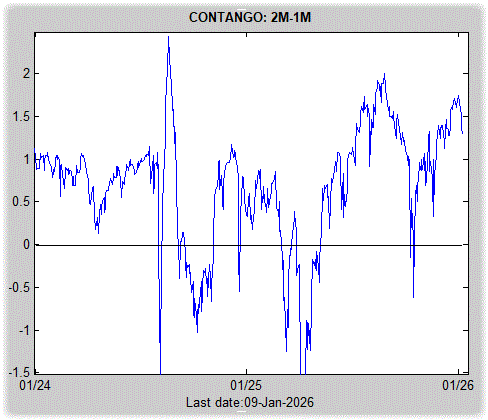
The figure above shows contango, measured as the price difference between the second-month and front-month VIX futures, and the figure below depicts the roll yield.

We observe that in the later part of 2025, the VIX futures term structure remained in a solid contango, and the roll yield was mostly positive. This environment created a drag on VXX (see the figure below), pushing it to a new low (while SVXY, not shown, reached a new high), even as the S&P 500 moved sideways without setting new highs.
After several years of declining roll yield, it has risen again and appears to have remained positive. Whether this reflects a structural change in the market is an open question, which we will continue to investigate and report on.

Around the Quantosphere
Everything we know about how Wall Street's biggest firms, from JPMorgan to Blackstone, are adopting AI (businessinsider)
Hedge funds battle over CDS of Coulson's junk-rated Ardagh (irishtimes)
Hedge Funds Hunt for Venezuela’s Unpaid Financial Claims (europeanbusinessmagazine)
Trump’s MBS Purchases Hand Traders Reason to Buy Long Bonds (bloomberg)
Market Regime Detection Artificial Intelligence (AI) (finance yahoo)
How to get a job at Jane Street (efinancialcareers-canada)
Brevan Howard profits slump as hedge fund misses out on macro trading boom (ft)
Is the hedge fund juice still worth the squeeze? (opalesque)
London's most secretive electronic trading firm is obfuscating its pay (efinancialcareers-canada)
The best hedge fund to work for is not even a hedge fund. (efinancialcareers-canada)
Canada Pensions Overseeing $1.2 Trillion Revamp Private Equity Model (bloomberg)
Commodities trades stung hedge funds this year (finance yahoo)
Disclaimer
This newsletter is not investment advice. It is provided solely for entertainment and educational purposes. Always consult a financial professional before making any investment decisions.
We are not responsible for any outcomes arising from the use of the content and codes provided in the outbound links. By continuing to read this newsletter, you acknowledge and agree to this disclaimer.